Imagine walking down the road with a cool eyebrow or septum piercing. So cool and edgy, right? But before you decide to get one, it is important to be aware of the most painful piercing and least painful piercing spots on the body to help determine the right one for you. Remember, a piercing requires time and commitment to ensure its longevity. So, whether you are a curious newbie or a seasoned expert looking for something different, this article provides you with insights into the healing time, pain level, and risks associated with different types of piercings. Scroll down to know more!
In This Article
Why Do Piercings Cause Pain?
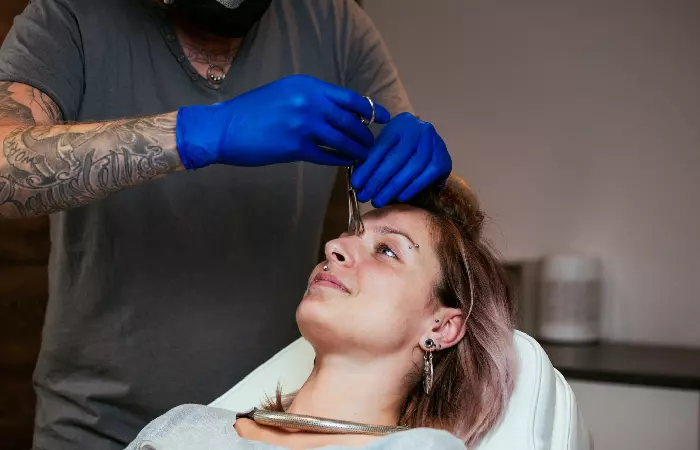
All forms of body piercing involve puncturing the skin with a sharp needle to create holes for the jewelry to thread in. That is why there is a level of pain associated with the piercing process. However, how uncomfortable or painful the actual process is depends on the person’s pain tolerance and the body piercer’s skill and expertise.
Some may report it as a pinch, others may report it as a quick sting or a very painful sensation. Ultimately, the perception of pain and the amount of attention given during the body modification process varies from person to person as some may deal with it better than other people ( 1 ).
Having said that, it is important to understand that pain is not always just physical, it can be mental too. Some people may like the pain they experience during the procedure, which might make their experience different from the ones who are nervous and cannot tolerate pain.
Another important factor that may play a role in this process is gender and how they cope with pain. For instance, men use problem-focused activities to distract themselves from the pain whereas women use social support to cope with pain ( 2 ).
Apart from this, the location and complexity of the piercing can also influence the pain level.
While the level of pain experienced by a person is subjective, everyone will experience an initial discomfort as the process involves puncturing the skin with a needle. However, the location also plays a key role as each body part experiences different levels of pain. Check out the section below for a piercing pain chart to get a better idea.
Key Takeaways
- The level of pain experienced during the body piercing procedure is highly subjective and can vary from person to person.
- The most painful piercing areas are the genitals and nipples.
- The least painful piercing areas are the belly button, tongue, and eyebrow.
Piercing Pain Chart
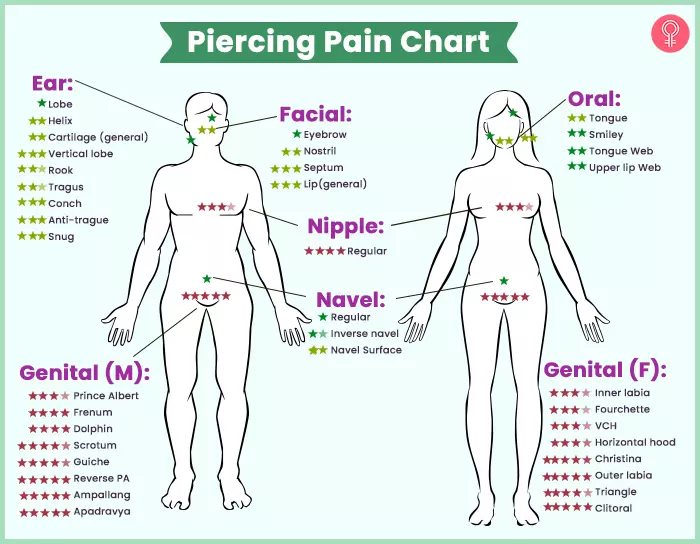
Whether you are a first-timer or a piercing enthusiast, looking at a piercing pain chart can help you prepare yourself before you take the plunge. The different colors in the chart indicate different levels of pain. However, one must keep in mind that piercing pain can vary from individual to individual depending on the pain tolerance level, mood, or whether or not the person has had sufficient sleep the night before the piercing appointment, etc. We have provided a piercing pain chart from the front and the back portion of the body to help you get a better idea.
As stated earlier, there is no one-size-fits-all approach to piercings. Regardless of where you decide to get the piercing done, having an idea about the different piercing sports can help ensure a more comfortable experience. Scroll down to the next section for the most and least painful piercing spots in the body.
8 Most Painful Piercings To Least Painful Piercings
Piercing may hurt
more on certain parts of the body such as the face and nipples due to the presence of nerve endings and less fat under the skin. Here is a breakdown of different types of piercings from most to least painful based on the level of pain they may cause and healing time.
Most Painful Piercings
As stated earlier, body areas with more nerve endings may experience more pain during the piercing process. Some of the most painful spots for piercing include:
- Genital Piercings
The genital area is considered the most painful place to get pierced due to the presence of a lot of nerve endings ( 3 ). Additionally, the level of pain may also depend on the location and complexity of the piercing. Similarly, the clitoris piercing may also be sensitive to pain due to the presence of abundant nerve endings ( 4 ). Another factor that contributes to the pain perception is the anxiety many people experience leading up to the piercing.
Pain Scale: 7/10 Healing Time: 4-6 weeks
- Nipple Piercings
It is probably the second most painful piercing spot after genital piercing. This erogenous zone is replete with nerves that directly connect to the brain, which means its overstimulation can elicit sexual pleasure but can lead to increased pain ( 5 ).
Pain Scale: 7/10 Healing Time: 9-12 months

A blogger shares her experience of getting a nipple piercing in her blog. She said, ” I was in so much pain and my breast was so large that it felt like it was going to burst. Ended up going to the local ER because it was after hours and the pain was unbearable ( i ).“
- Nose Piercings
The pain level depends on the location of the piercing. Here are some nose piercings and their pain level:
- Septum Piercing
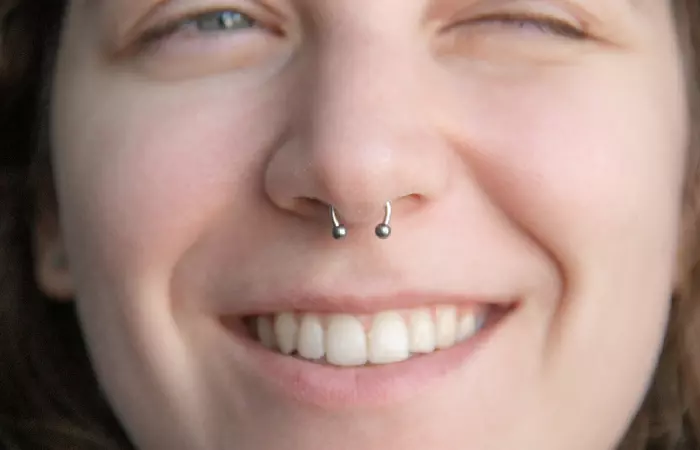
It can be very painful as it involves piercing through the septum or the tissue between the two nostrils. On a similar line deviated septum or overactive septum nerve condition can also make the feeling of being pierced much more intense here.
Pain Scale: 6/10 Healing Time: 2-6 months
- High Nostril Piercing
View this post on Instagram A post shared by New York Adorned (@newyorkadorned)
This type of piercing involves piercing the top area of the nose with thicker cartilage, which may hurt more compared to areas with more fat and take longer to heal as well.
Pain Scale: 5/10 Healing Time: 4-6 months
- Dermal Piercings
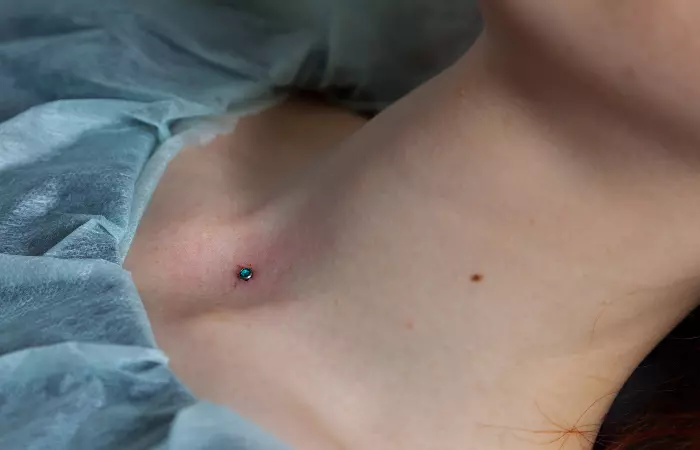
This skin piercing involves creating a puncture with no exit hole, unlike traditional piercings. The pain level can vary depending on the amount of nerve endings present, the skin thickness, and the closeness to the veins.
Pain Scale: 6/10 Healing Time: 1-3 months

If you are someone who does not have a good pain tolerance, then here are some of the least painful piercing spots you should be aware of. Scroll down to find out.
Least Painful Piercings
Areas with fat and fewer nerve endings are likely to cause less piercing pain as compared to bony areas. Some of the least painful spots for piercing include:
- Ear Piercings
Ear piercings are a popular and common choice among newbies and enthusiasts because they generally hurt less due to the presence of delicate tissues. Some of these types of ear piercings include:
- Helix Piercing
View this post on Instagram A post shared by Annett Staygold (@staygold_piercing)
It involves piercing the outer edge of the upper ear cartilage. Many people get double or triple ear piercings in this area due to the thin cartilage tissues.
Pain Scale: 4/10 Healing Time: 3-6 months
- Earlobe Piercing
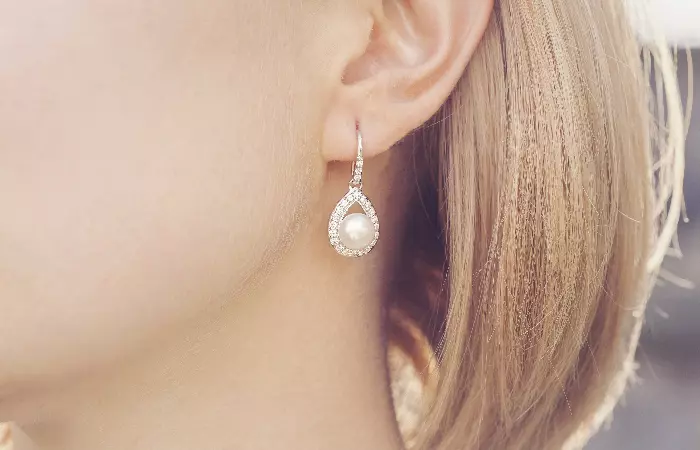
The earlobe piercing involves piercing the lower, flesh part of the ear. This is one of the most common ear piercings among children and adults due to the low pain level.
Pain Scale: 3/10 Healing Time: 4-6 months
- Belly Button Piercing
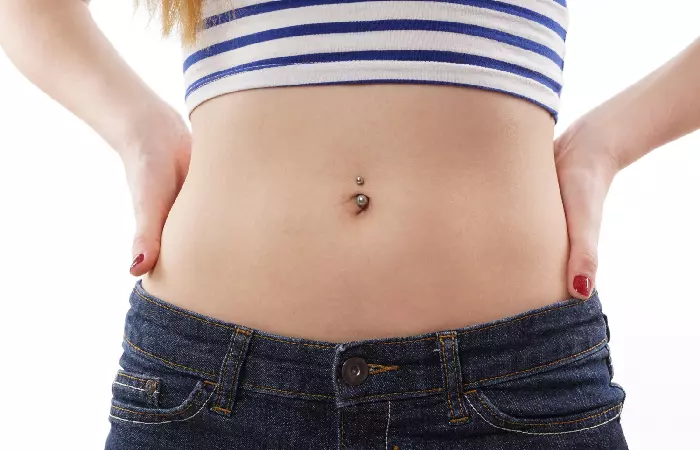
Navel piercings are considered one of the least painful piercings due to the presence of thicker skin and fewer nerve endings, making them a popular and edgy piercing around the globe.
Pain Scale: 4/10 Healing Time: 6-12 months
- Eyebrow Piercings
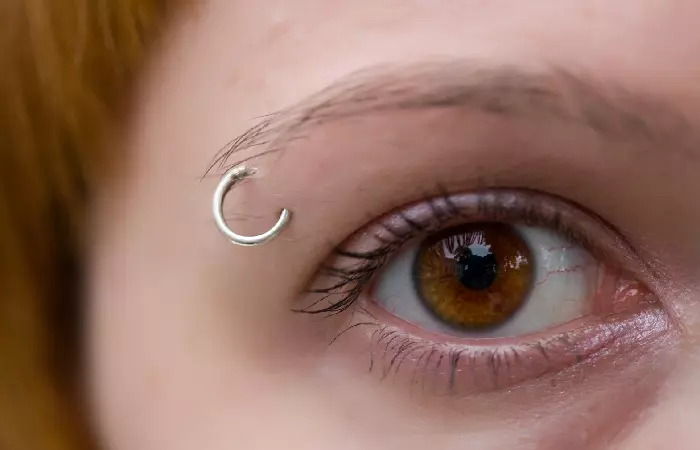
This facial piercing does not usually hurt too badly. Even though there are some nerves present in the brow area, the needle doesn’t puncture through a lot of skin, making the pain level low. These piercings are considered more masculine and even make for a popular piercing for men .
Pain Scale: 3/10 Healing Time: 3 months
- Tongue Piercings
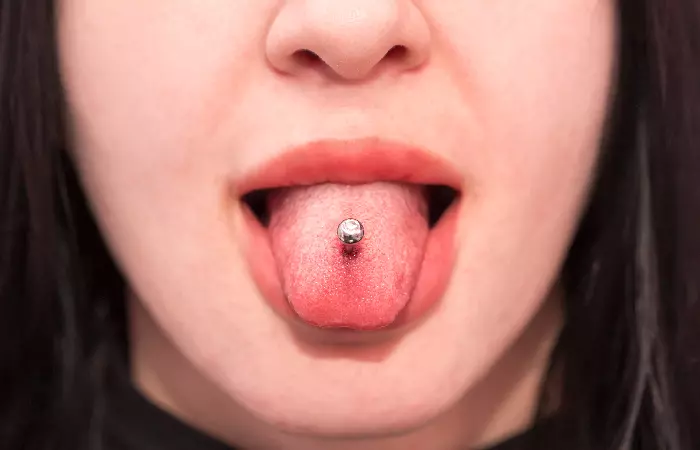
While the tongue might feel like a sensitive spot, in reality, many consider the pain low because the needle pierces through a lot of connective tissues than the cartilage or skin.
However, one must also note that this area may take some time to heal due to it being wet, which may increase the risk of infection.
Pain Scale: 4/10 Healing Time: 4-8 weeks
Piercings continue to reign supreme in the realm of body modification. They are edgy and allow people to express themselves unabashedly. However, understanding the pain level associated with piercing different areas of the body can help you make an informed decision and manage your anxiety during the piercing process. Therefore, research and find a professional piercer. Go through the piercing pain chart together and understand the pros and cons of each piercing and its healing period before finalizing the one you want.
Infographic: 4 Most Painful Piercings
There is no doubt that the piercing process does hurt, but the pain experienced can be different for everyone and depends on the piercing location. Some areas are more sensitive and can hurt more than others. If you are someone who has decided to take the plunge and want to know what body parts can cause more pain and discomfort, check out the infographic below to find your answers.
How can I manage pain after getting a piercing?
To reduce pain, apply a cold compress to the area and take over-the-counter pain relievers. Avoid sleeping on or irritating the piercing, and keep it clean to help with healing.
Can certain health conditions affect the pain of a piercing?
Yes, conditions such as blood disorders, autoimmune disorders, skin allergies, pregnancy, etc can cause inflammation and make one more sensitive to pain or the perception of pain ( 6 ), ( 7 ), ( 8 ), ( 9 ).
How does the pain of a piercing compare to other body modifications?
The pain of piercing can vary depending upon the individual pain threshold, placement, and complexity of the piercing. However, most people report the pain as a brief and sharp sensation. On the other hand, a process like tattooing and dermal implants can cause severe and intense pain during the procedure.
Piercing some body parts may hurt a little more than others. So, if you are thinking of getting one, check out this video to learn about the least painful piercing spots in the body.
Personal Experience: Source
StyleCraze’s articles are interwoven with authentic personal narratives that provide depth and resonance to our content. Below are the sources of the personal accounts referenced in this article.
(i). Nipple Piercing Horror Story https://nipplepiercingbad.blogspot.com/2010/09/my-experience-with-nipple-piercings.html
References
- Pain from perception to action: A computational perspective https://www.ncbi.nlm.nih.gov/pmc/articles/PMC9771728/
- Sex differences in pain: a brief review of clinical and experimental findings https://www.ncbi.nlm.nih.gov/pmc/articles/PMC3690315/#:~:text=While%20men%20tend%20to%20use,cognitive%20reinterpretation%2C%20and%20attentional%20focus.
- Anatomy Abdomen and Pelvis Penis https://www.ncbi.nlm.nih.gov/books/NBK482236/#:~:text=The%20glans%20penis%20has%20a,arteries%20which%20supply%20erectile%20tissue.
- Management of Retained Genital Piercings: A Case Report and Review https://downloads.hindawi.com/journals/criog/2017/2402145.pdf
- Women’s clitoris vagina and cervix mapped on the sensory cortex: fMRI evidence https://pubmed.ncbi.nlm.nih.gov/21797981/
- Pain and pain management in haemophilia https://www.ncbi.nlm.nih.gov/pmc/articles/PMC5087566/
- Autoimmune regulation of chronic pain https://www.ncbi.nlm.nih.gov/pmc/articles/PMC8108590/#:~:text=Pain%20in%20autoimmune%20disease%20has,of%20proinflammatory%20cytokines%20or%20peptides.
- Dermatological Conditions Inducing Acute and Chronic Pain https://www.ncbi.nlm.nih.gov/pmc/articles/PMC9609987/#:~:text=Some%20skin%20diseases%20are%20conventionally,can%20also%20cause%20significant%20pain.
- Individual Characteristics and Pain Sensitivity during Pregnancy—A Cross-Sectional Study in Pregnant and Non-Pregnant Women https://www.ncbi.nlm.nih.gov/pmc/articles/PMC9657085/#:~:text=The%20main%20results%20of%20the,than%20in%20the%20comparison%20group.
Guide to the Most & Least Painful Piercings
Watch this video to discover which piercings hurt most or least, explore healing times, and conquer anxiety with our detailed piercing pain chart insights. Watch now!


Community Experiences
Join the conversation and become a part of our empowering community! Share your stories, experiences, and insights to connect with other beauty, lifestyle, and health enthusiasts.


Nothing compares to the peace and serenity of waking through a forest all by yourself. It is almost like the trees and the wind speak to you, and you begin to walk closer to nature leaving the stress of the concrete jungle behind. Even in the world of body art, forest tattoos are very popular among nature lovers and they also carry a deep meaning. Be it the dense pine forest, falls in the deciduous forests, or wild animals, your tattoo can depict your personality better than anything else. If you would like to get a forest tattoo done, we have some creative unique ideas that will surely inspire you for your next inking. Keep reading!
In This Article
Forest Tattoo Meaning
Forest tattoos symbolize a connection between nature and our life. It helps us connect to the serenity that most of us struggle to find in our lives. Forest body arts capture the beauty of undisturbed nature and remind you to stay close to it. The tattoos can be drawn using diverse styles and each design can be customized to add more meaning to it. They also signify strength, fertility, and nourishment. Some even believe it is a sign of spirituality, immortality, and freedom. Forests also symbolize growth and transformation. So, forest tattoos can inspire individuals to overcome life’s challenges to grow and develop in life. Forests withstand strong winds, wildfires, and other natural disasters. So, they also represent endurance and resilience.
To make your forest tattoo more meaningful, you can add animals to it. Some people include their spirit animals in the tattoo while some add names. The more you explore the more options and ideas you will be able to get. Check out the next section on how to select the right forest tattoo design!
Tips For Choosing Your Forest Tattoo
- Forest tattoos can be small and subtle or large or detailed, pick a tattoo size that resonates with your personal preferences, aesthetics, and budget. Small tattoos are typically great for those who are new to the tattooing world and are given to minimalistic sensibilities.
- If you are going for a detailed and complex tattoo opt for flat areas like the chest or the upper as it reads well there. While, if you are going for a dainty or wrap-around forest design, opt for arms and legs as these designs can perfectly fit to the curves and contours of these areas.
- Go for forest tattoos in black ink, if you like sophisticated and timeless designs. Opt for colorful forest tattoos, if you have a lively, happy, and energetic personality.
- Consider a forest tattoo of personal importance. Customize a design that carries a sentimental meaning, is inspiring, reminds you of a dear one, or a major life-changing event in life.
The above-listed tips can help you walk away with a forest tattoo art that not only resonates with your personal style but also complements the flow of your body. Now, let’s move on to see some incredible forest tattoo designs.
8 Amazing Forest Tattoo Designs
Here are some meaningful and one-of-a-kind forest tattoos to make your body art unique. Browse through them so you can get ideas for the one tattoo that will unite you with the nature-loving side of you.
1. Half Arm Forest Tattoo
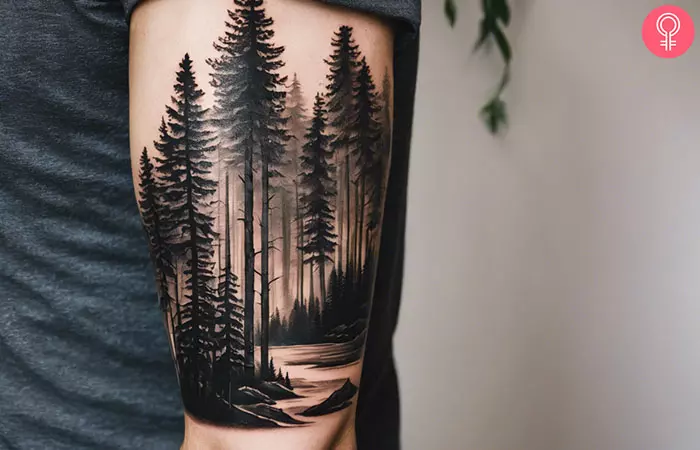
Half-arm tattoos are always a great option for tattooing. They are easily visible when you wear a half-sleeve shirt or t-shirt and can be concealed under full-sleeve attires if you are attending a formal event. This tattoo on the upper arm depicts tall pine trees reaching toward the sky, symbolizing the resilience of nature. The silhouette of the forest and the blackwork-style shading effectively capture the mystery and allure of a forest.
2. Forest Sleeve Tattoo
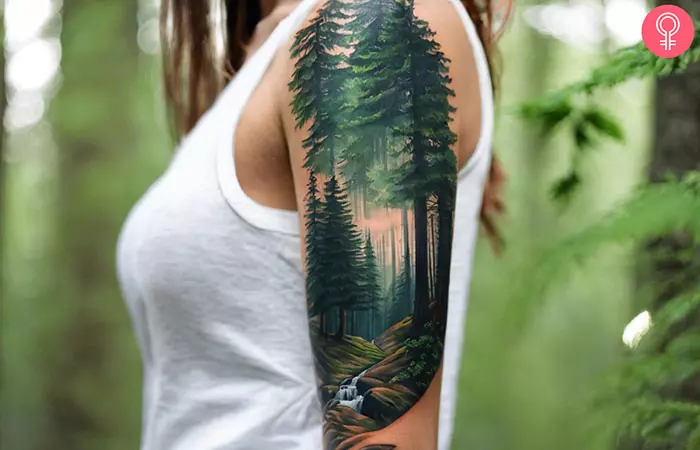
Just one look at this realistic tattoo and you know you want it. This gorgeous piece of art is the best sleeve tattoo you can ever invest in. The color palette consists mainly of the color green. The highlights and shade are surreal. The tall trees and path make it perfect for your sleeve. If you don’t want the entire sleeve covered, you can keep the art to your forearm. Though this realistic art might be expensive, the overall look is worth it!
3. Forest Forearm Tattoo
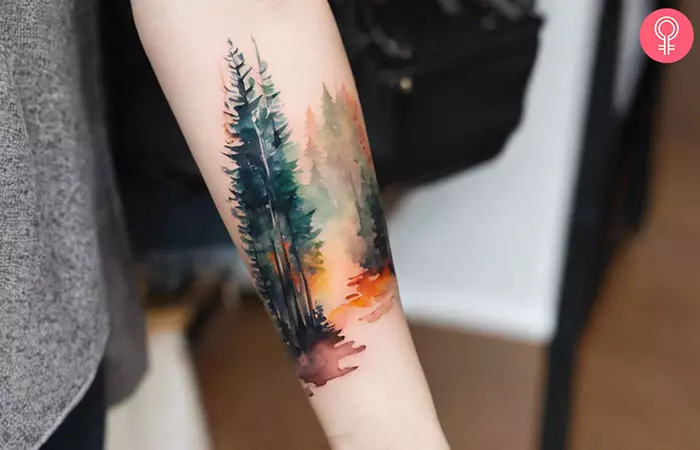
Forearms are a great place to flaunt your body art. It gives a lot of space and the perfect curvature for your tattoo artist to ink on. This forest tattoo is done in watercolor style and has a very colorful appeal. The use of green and orange with shade work makes it a perfect artwork on your skin.
4. Dark Forest Tattoo
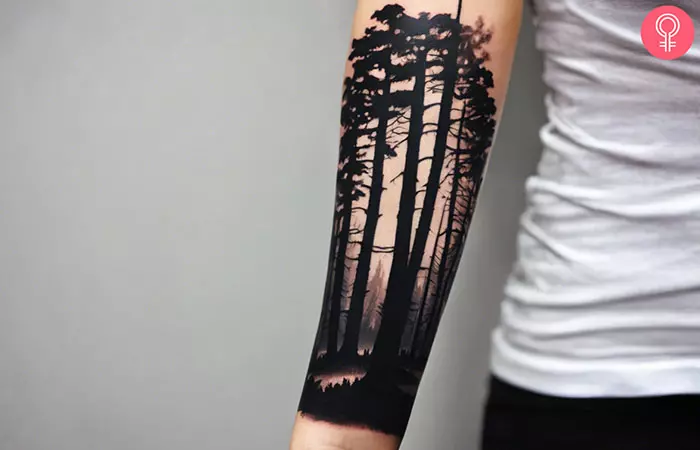
There is something about a dark and mysterious jungle tattoos that draws you closer. This tattoo of a dark forest is beautifully inked on the forearm. While the trees are drawn in dark ink, the background forms a hazy art that adds more mystery to the tattoo. The realistic art style makes this tattoo even more intriguing. You can scale it up or down and place it on any part of your body.
5. Wrist Forest Tattoo
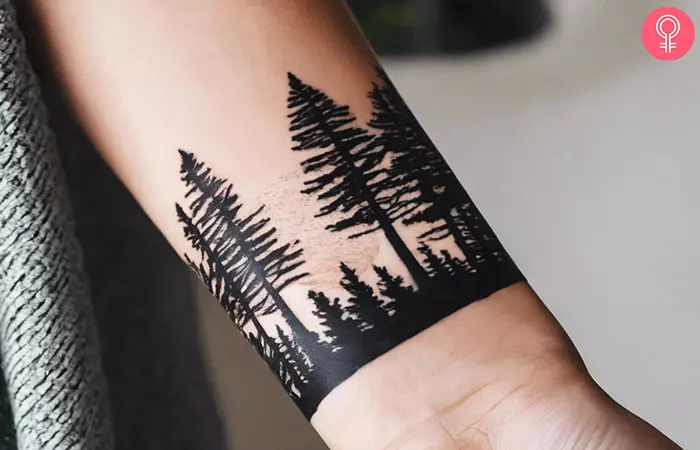
Wrist tattoos are a wonderful place to flaunt your body art. The design can be minimal, elaborate, or colorful, this is the first place people notice your tattoo. This tattoo design wraps around the wrist and depicts the silhouette of a pine forest. Pine tree tattoos give the tattoo a very green and wholesome element. Notice the subtle form of the sun, with softer edges, in a pale yellow shade in the backdrop. While the forest is a reminder of your own growth, the sun may symbolize a constant source of guidance.
6. Forest And Mountain Tattoo Sleeve
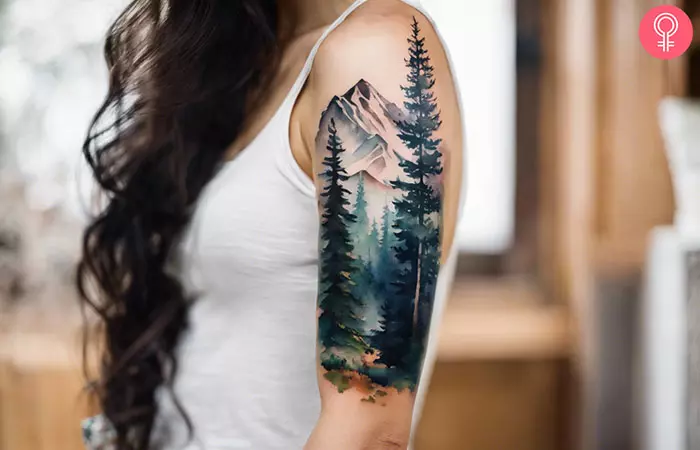
Forests and mountains make the best pair and when drawn in a tattoo, it adds to the beauty of it. This design is a forever favorite among nature lovers and hikers. It has beautiful color shading. The watercolor-style soft and blended colors give a dreamy effect to the forest tattoo and the snow-capped mountains in the backdrop add an element of wonder to it. The tattoo can be placed on the lower sleeve as well and you may add more elements, like meadow and grass, to cover your entire arm. You can also add tribal flower tattoos to the design to give it a traditional feel.
7. Wolf Forest Tattoo
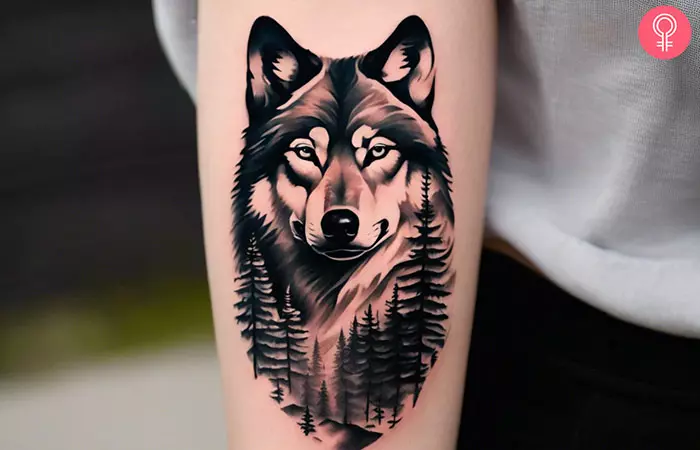
If you are a fan of wolf tattoos, this design will surely attract you. It is made using realistic style and the dark ink shades blend beautifully with one another to form a lone wolf. Placed on the forearm the tattoo looks gorgeous. It has elements like pine trees at the bottom of the tattoo. It is surely one of a kind and if you are a nature tattoo lover, this is the design you should go for.
8. Silhouette Wolf Forest Tattoo
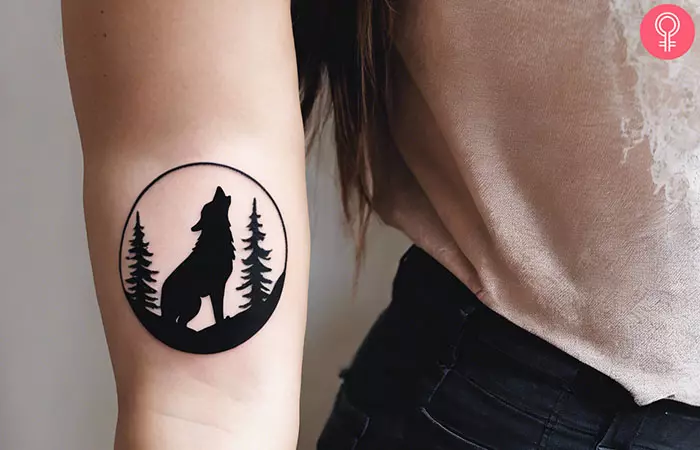
This tattoo has a separate fan base. It carries a deep meaning of spiritual protection. Paired with elements of forest, the art becomes even more authentic. This tattoo on the forearm features a silhouette of a wolf in a circle with two pine trees. The best part about the tattoo is that you can scale it and place it on different parts of the body. It is made with black ink which makes it suitable for all skin tones.
There is no end to how creative you can get with your forest tattoos. The more you look at designs the more inspired you will be. You can also take different elements of the forest you like and turn it into a sleeve tattoo. Make sure you get your realistic tattoos done by seasoned artists only. Make sure you commit to the aftercare to keep the design fresh for a long time. A little TLC goes a long way!
8 Forest Tattoo Designs to Inspire Your Next Ink
Watch our video to explore 8 stunning forest tattoo designs, learn their meanings, and discover tips on size, style, and placement. Dive in now to find your ideal ink!
Community Experiences
Join the conversation and become a part of our empowering community! Share your stories, experiences, and insights to connect with other beauty, lifestyle, and health enthusiasts.


