Scars are very common as they are a part of the body’s natural healing process. They can be caused by injuries, surgeries, burns, skin disorders such as acne, and other types of physical traumas. Since scarring is so common, there is a significant demand for effective therapeutic solutions. People swear by coconut oil for scars as it is believed to reduce the visibility of scars and enhance the skin’s overall appearance. Could this be true? Let ‘s see what we can find out!

In This Article
Coconut Oil For Scars And Wounds: A Look At Its All-Round Benefits

Shutterstock
Coconut oil has a hydrating and moisturizing effect on the skin (particularly dry skin) and is an excellent oil for skin massages ( 1 ). Using coconut oil for skin can hydrate, nourish, and protect it from environmental damage. Moreover, it can prevent dryness and flaking of the skin and is thus extensively used in skin care. This moisturizing property of coconut oil may help with early scar treatment, especially if the skin is dry and damaged.
The same research claims that when applied to infected areas, coconut oil forms a chemical layer and protects the infected body part from external dust, air, fungi, bacteria, and viruses. Hence, coconut oil is highly effective on bruises as it can accelerate the healing process of damaged tissues ( 1 ).
Another study suggests that coconut oil can boost collagen production and help the skin tissues heal quickly ( 2 ). This can encourage new tissue development. Additionally, coconut oil can even out the skin tone and reduce redness caused by scarring. However, more research is warranted in this regard.
The takeaway: According to research, this powerhouse of an ingredient can assist in scar-healing and can be used as a therapeutic agent ( 3 ). Data suggests that it could be included as an active ingredient in wound management.
Sara Grace, a YouTuber, enthusiastically shares various uses of coconut oil, emphasizing its versatility and affordability. Highlighting personal success, she asserted coconut oil significantly aided in healing acne and scarring. She says, “I thought smearing oil on acne is not going to help heal it y’all I swear I started just washing my face and using this as my moisturizer everyday and as a treatment at night and I swear to you it healed my acne and it healed the scarring ( i ).”
So, how does coconut oil hold up to vitamin E? Let’s find out in the section below.

Key Takeaways
- Coconut oil has a hydrating and moisturizing effect on the skin and may help with early scar treatment.
- Coconut oil forms a chemical layer over the infected body parts and protects them from external dust, air, fungi, bacteria, and viruses.
- Coconut oil is generally well tolerated. However, some people may experience extreme reactions if they are allergic to coconuts.
Coconut Oil Vs. Vitamin E: Which Is Better For Scar Treatment?
Coconut oil and vitamin E are popular natural remedies for scar treatment and skin healing, with each having distinct characteristics. Known for its antioxidant properties, vitamin E can help protect and repair skin cells from damage ( 4 ). Applying vitamin E oil or cream directly onto a scar can moisturize the area, reducing redness and itching; however, scientific evidence of such is limited.
Coconut oil, on the other hand, is primarily a moisturizer for soft skin. Its lauric acid content gives it anti-inflammatory and antimicrobial attributes that can potentially reduce redness and prevent scar-related infections ( 3 ). There is limited scientific evidence supporting its scar-reduction properties as it keeps the skin hydrated, thereby indirectly aiding scar healing and restoring overall skin health.
How To Treat Scars Using Coconut Oil
Shutterstock
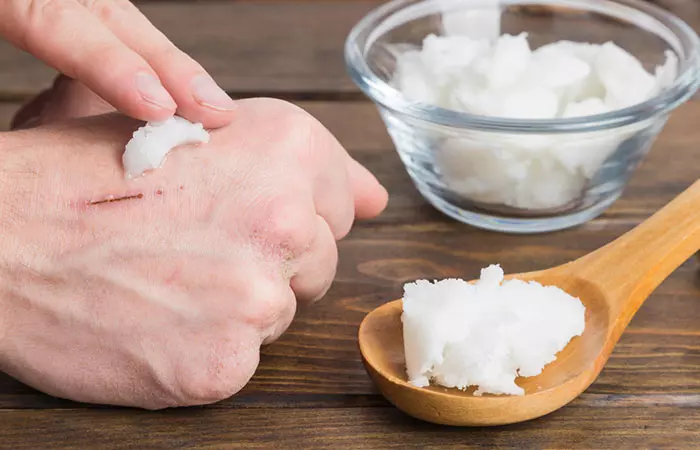
You can use coconut oil twice a day – once in the morning and once at night. Start by doing a patch test to see if you are allergic to the oil:
- Apply a small amount of the product to your forearm.
- Use a bandage to cover the area.
- If you do not experience any irritation, redness, or inflammation within 24 hours, you can continue using it.
DIY Recipe Using Coconut Oil For Treating Scars
Shutterstock
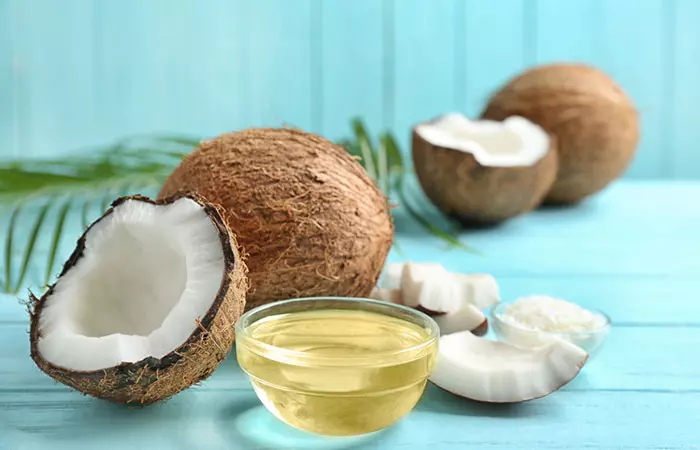
- Heat a few tablespoons of coconut oil to ensure it is liquefied.
- Gently massage the oil in circular motions into the scar for at least 10 minutes. You may even add some other carrier oils or essential oils.
- Let the skin absorb the oil for at least sixty minutes.
- Repeat this process at least 2 to 4 times a day for the best results.
Pro tip:
Home remedies such as coconut oil cannot be a replacement for sunscreen. Make sure to wear an SPF 30 (or higher) sunscreen every day to prevent sun damage and keep your scars from darkening.
When You Should Seek Professional Treatment
Shutterstock
Coconut oil is a natural product. But you still should consult your dermatologist before using it (or any other ingredient) to treat your scars at home.
Do a patch test to see if you are allergic to coconut oil. If you experience any irritation or redness, stop using immediately and seek professional help.
Possible Side Effects And Risks

Shutterstock
Coconut oil is generally well-tolerated among people of all age groups and in all skin types. However, some people can experience extreme reactions if they are allergic to coconuts (do a patch test first). Also, extra virgin coconut oil contains high amounts of antioxidants, such as vitamin E and may cause contact dermatitis i A general term that describes a common skin irritation that usually involves itchy, dry skin or a rash in response to an allergy. when applied to surgical scars ( 4 ), ( 5 ). For those with acne-prone skin, using coconut oil might worsen breakouts, so it’s a good idea to check with a dermatologist before applying it regularly.
Infographic: Coconut Oil For Scars: Benefits And Tips To Use It
Scarring is a common issue and occurs during the body’s natural healing process. Although all scars do not completely fade away, you can use natural anti-inflammatory and wound healing remedies to reduce the appearance of scars. Using coconut oil for scars is one of the most effective ways to get rid of these stubborn scars.
Coconut oil helps boost collagen production and moisturize your skin, reducing scars, and improving skin texture. It also helps improve skin issues, such as eczema, psoriasis, and hyperpigmentation. Since there is not enough research to back this claim, you may consult your dermatologist before using this oil for scar treatment. Always do a patch test before you incorporate it into your treatment.
Does coconut oil fade old scars, dark spots, and acne scars?
Anecdotal evidence suggests that coconut oil may help fade scars and dark spots as it keeps your skin moisturized and boosts collagen production to stimulate cellular turnover. However, we have not added it as a beauty tip as there is no scientific evidence to support the claim.
How long does coconut oil take to brighten skin?
Coconut oil may take at least one month to make your skin visibly brighter.
Can I use coconut oil on my skin every day?
You may use it sparingly to moisturize dry and chafed skin. Since it is a comedogenic i A product or a drug that clogs the skin pores by blocking them and results in blackhead formation and pimples. oil, it may cause breakouts. Therefore, avoid using coconut oil if you have oily and acne-prone skin.
Can I apply coconut oil to face overnight?
No. You shouldn’t leave coconut oil on your skin overnight as it is a comedogenic ingredient and may cause breakout by clogging your pores.
Can coconut oil remove stretch marks?
While there is no scientific evidence to prove this, some say they used coconut oil for stretch marks regularly and saw improvement in the appearance of their stretch marks. This could be accredited to the deeply hydrating and boosting collagen nature of the oil.
Illustration: Coconut Oil For Scars: An Effective Remedy?
Image: Stable Diffusion/StyleCraze Design Team
Personal Experience: Source
StyleCraze’s articles are interwoven with authentic personal narratives that provide depth and resonance to our content. Below are the sources of the personal accounts referenced in this article.
References
- Medicinal benefit of coconut oil https://www.researchgate.net/publication/268805677_Medicinal_benefit_of_coconut_oil
- Effect of topical application of virgin coconut oil on skin components and antioxidant status during dermal wound healing in young rats https://pubmed.ncbi.nlm.nih.gov/20523108/
- ALTERNATIVE WOUND HEALING EFFECTS OF COCONUT OIL EXTRACT USING ADULT WISTAR RATS https://www.researchgate.net/publication/332622179_ALTERNATIVE_WOUND_HEALING_EFFECTS_OF_COCONUT_OIL_EXTRACT_USING_ADULT_WISTAR_RATS
- The effects of topical vitamin E on the cosmetic appearance of scars https://pubmed.ncbi.nlm.nih.gov/10417589/
- Coconut oil: what do we really know about it so far? https://www.researchgate.net/publication/332565821_Coconut_oil_what_do_we_really_know_about_it_so_far



Community Experiences
Join the conversation and become a part of our empowering community! Share your stories, experiences, and insights to connect with other beauty, lifestyle, and health enthusiasts.


