In This Article
What Is Listerine?
Listerine is an American brand of antiseptic mouthwash and other oral care products, such as mouth sprays, toothpaste, and floss. Listerine mouthwash is an essential oil-containing mouthwash. It contains natural compounds such as menthol (from mint), eucalyptol (from eucalyptus), and thymol (from thyme) that help in reducing plaque and improving the health of gingival tissue ( 1 ). It is named after Sir Joseph Lister, founder of the practice of antiseptic medicine.
Listerine is mainly used to get rid of bad breath and maintain oral hygiene. But can this antiseptic liquid help in getting rid of dandruff? Find out in the next section.

Key Takeaways
- Listerine has antifungal properties that may reduce dandruff and improve scalp health.
- It contains anti-dandruff agents like eucalyptol and salicylic acid. It also has thyme, an antiseptic, and menthol with antimicrobial properties.
- Mix some Listerine and water together to dilute it and spray it over the hair.
- Mix Listerine with ingredients like coconut oil, vinegar, and peppermint oil to keep your scalp clean and healthy.
Listerine And Dandruff
Shutterstock
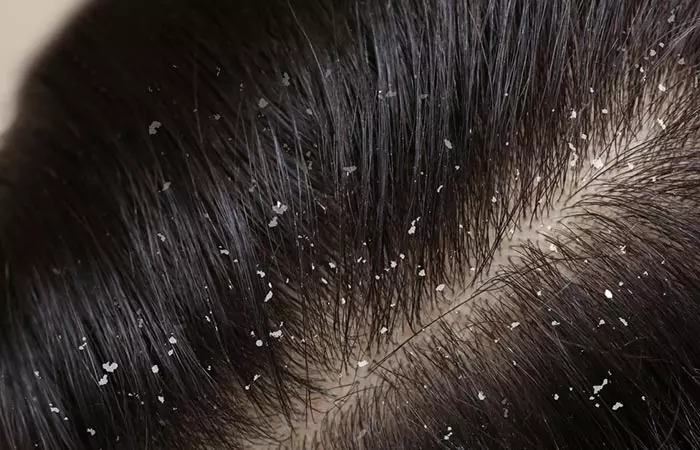
Joseph Lawrence developed Listerine in 1879. He named it after being inspired by Dr.Joseph Lister, who was trying to create the first antiseptic surgical solution. When it first came out, Listerine was publicized as an antiseptic solution. Since the 1920s, Listerine was advertised as being able to get rid of dandruff. Lawrence conducted an experiment with rabbits that showed Listerine could indeed prevent dandruff. Later on, the company got in trouble with the law for calling dandruff a germ.
A lot of anecdotal evidence suggests that Listerine can be used to get rid of dandruff. Let’s look at what science says.
How Listerine Prevents Dandruff
Shutterstock
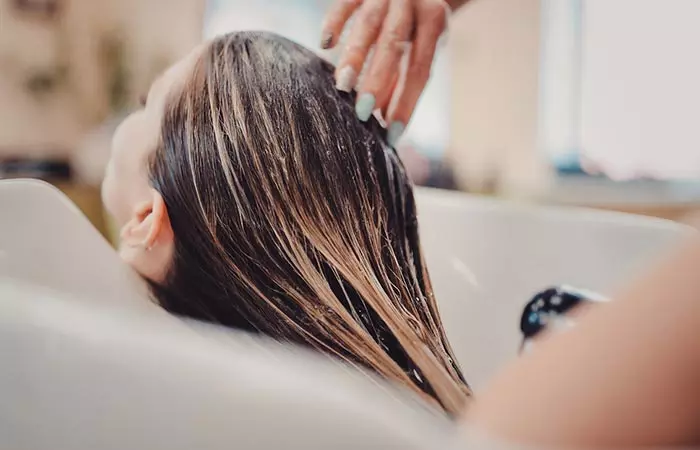
There is little to no scientific research to establish that Listerine helps reduce dandruff. Here are some ways Listerine may prevent dandruff:
- Listerine contains four main components: menthol, thymol, eucalyptol, and methyl salicylate.
- Thyme is a well-known antiseptic that can help reduce dandruff ( 2 )( 3 ) Menthol has antimicrobial properties ( 4 ). It may prevent a flaky scalp and help keep it clean. Eucalyptol (1-8, Cineol) can work well as an anti-dandruff agent ( 5 ). Salicylic acid is often used in anti-dandruff shampoos, and it helps remove scalp scales/flakes ( 6 ).
- Listerine exhibits antimicrobial and antifungal activities ( 7 ), ( 8 ). It may therefore help manage fungal infections and scalp issues like dandruff to some extent and improve scalp health.
- Listerine is antiseptic and can help prevent viral and fungal scalp infections .
Additionally, some anecdotal report also suggest the use of this product for lice! Fariha Farhana, a blogger, shared her experience of using Listerine for head lice infestation and saw great results. She said, “The result was unbelievably good. I got rid of most of my lice and nits ( i ).”
Now that we have understood Listerine’s potential to manage some hair health issues, let us continue on to the next section to understand how to use it to tackle scalp issues like dandruff.
How To Use Listerine For Dandruff
Here’s how to get rid of dandruff using Listerine.
1. Listerine For Dandruff
You Will Need
- 1 tablespoon Listerine
- Cotton pad
Prep Time
2 minutes
Treatment Time
5-10 minutes
Method
- Soak the cotton pad in the Listerine and dab it onto your scalp.
- Let it sit for about 5-10 minutes.
- Wash your hair with a mild shampoo and finish with a conditioner.
How Often
2-3 times a week for 2 weeks.
2. Listerine And Water For Dandruff

Shutterstock
Listerine contains compounds that have antifungal, antibacterial, and antimicrobial properties. It is also antiseptic, which may help reduce symptoms associated with dandruff and seborrheic dermatitis.
You Will Need
- 2 tablespoons Listerine
- 2 tablespoons water
- Spray bottle
Prep Time
2 minutes
Treatment Time
5 minutes
Method
- Pour the ingredients into a spray bottle and mix well.
- Wash your hair with your regular shampoo and condition.
- Spritz the diluted Listerine onto your scalp and let it sit for a couple of minutes.
- Rinse your scalp with cool/lukewarm water.
How Often?
3 times a week for 2 weeks.
3. Listerine And Coconut Oil For Dandruff
Shutterstock
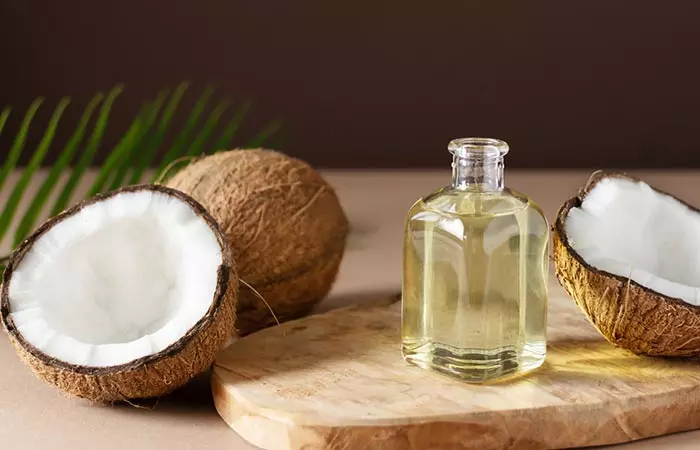
Coconut oil can penetrate the hair shaft, passing through the cortex as well. It can prevent and repair hair damage ( 9 ). The oil helps Listerine enter the hair follicles, prevents microbial infections, and keeps the scalp clean . Further, it’s one of the simplest ways to indulge in some hair care.
You Will Need
- 2 tablespoons Listerine
- 2 tablespoons coconut oil
Prep Time
2 minutes
Treatment Time
5 minutes
Method
- Combine the Listerine with an equal amount of coconut oil and set aside.
- Wash your hair with a mild sulfate-free shampoo. Do not condition.
- Squeeze the excess water out of your hair.
- Tilting your head back, pour the Listerine and coconut oil mixture on your scalp.
- Scalp massage can improve blood circulation and thus improve scalp health. Make sure to leave the oil mixture on for about 5 minutes.
- Wash the oil and Listerine out of your hair with a mild shampoo.
How Often?
3 times a week for 2 weeks.
4. Listerine And Vinegar For Dandruff
Shutterstock
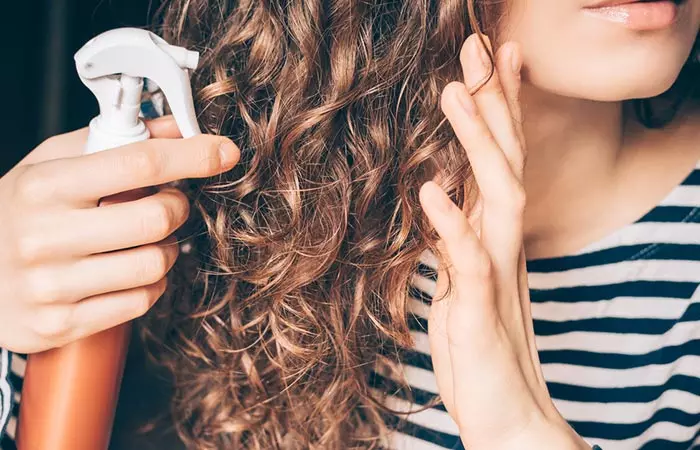
Vinegar is said to help maintain the pH balance of the scalp. It is also known to help cleanse the scalp, which may improve scalp and hair health.
You Will Need
- 2 tablespoons Listerine
- 2 tablespoons water
- 1 tablespoon apple cider vinegar
- 1 cup water
- Spray bottle
Prep Time
2 minutes
Treatment Time
5 minutes
Method
- Pour equal parts of Listerine and water into a spray bottle and mix well.
- Wash your hair with your regular shampoo and condition it.
- Spritz the diluted Listerine on your scalp and let it sit for a couple of minutes.
- Rinse your scalp with cool/lukewarm water.
- Dilute the apple cider vinegar with a cup of water. Pour this mixture through your hair as a final rinse.
How Often?
Once a week.
5. Listerine and Peppermint Oil
Peppermint oil has a cooling effect on your scalp and helps eliminate dandruff and lice ( 10 ). You can add coconut oil if you feel there is too much menthol, and your scalp is tingling.
You Will Need
- 1 cap Listerine
- 2 tablespoons peppermint oil
- 1 tablespoon coconut oil
Prep Time
2 minutes
Treatment Time
5-10 minutes
Process
- Mix the Listerine and the oils.
- Apply the blend to your scalp.
- Keep it on for about 5-10 minutes.
- Wash it off with a mild shampoo.
How Often
Once a week.
Note: If you have a history of skin sensitivity, it’s advisable to consult a dermatologist before using Listerine on your scalp to ensure it’s a safe option for you.

Infographic: 5 Ways To Use Listerine For Dandruff
Listerine has been widely used as a mouthwash for killing bacteria that cause bad breath. However, it has come to be effective for a number of other uses as well. One of the emerging uses of Listerine is the treatment of dandruff. Check out the infographic below to find out the different ways you can use it to treat dandruff.
A lot of anecdotal data suggests that Listerine can be used to get rid of dandruff. Listerine, a common mouthwash, contains antifungal agents that aid in killing the source of the problem, restoring your scalp’s health. It not only gets rid of dandruff but also soothes your scalp and makes it feel cool and rejuvenated. However, you must be careful when using mouthwash. If you have damaged skin or cuts, you should not use Listerine until they have healed. However, keep in mind that it may be useful in minor situations but not in moderate to severe ones. As a result, if you have a lot of dandruff, you should see a dermatologist to get the right treatment.
Is Listerine good for itchy scalp?
Listerine contains menthol which may help in reducing scalp itchiness ( 11 ).
Should I use Listerine every day?
No, you should not use Listerine daily as it may cause scalp irritation. You can use it every 3 to 4 months.
Is Listerine good for scalp psoriasis i An immune-mediated disease triggered by cold, infection, or stress and causes red, scaly, and itchy patches on the skin. ?
There is currently no scientific evidence that suggests that Listerine may help manage scalp psoriasis.
References
- Alshehri, Fahad Ali (2018). “The use of mouthwash containing essential oils (LISTERINE®) to improve oral health: Saudi Dent J. 30(1): 2–6. https://www.ncbi.nlm.nih.gov/pmc/articles/PMC6112363/
- Dodiya, Tanvi. (2013). “Herbal armamentarium for the culprit dandruff.” International Journal of phytopharmacy research. 4. 23-28. https://www.researchgate.net/publication/301899530_Herbal_armamentarium_for_the_culprit_dandruff
- Zaid, Abdel Naser et al. “Ethnopharmacological survey of home remedies used for treatment of hair and scalp and their methods of preparation in the West Bank-Palestine.” BMC complementary and alternative medicine vol. 17,1 355. https://www.ncbi.nlm.nih.gov/pmc/articles/PMC5499037/
- Trombetta, Domenico et al. “Mechanisms of antibacterial action of three monoterpenes.” Antimicrobial agents and chemotherapy vol. 49,6 (2005): 2474-8. https://pubmed.ncbi.nlm.nih.gov/15917549/
- “Studies on the antidandruff activity of the essential oil of coleus amboinicus and eucalyptus globulus”, Asian Pacific Journal of Tropical Disease, ScienceDirect. https://www.sciencedirect.com/science/article/abs/pii/S2222180812602503?via%3Dihub
- Ranganathan, S, and T Mukhopadhyay. “Dandruff: the most commercially exploited skin disease.” Indian journal of dermatology vol. 55,2 (2010): 130-4. https://www.ncbi.nlm.nih.gov/pmc/articles/PMC2887514/
- Richa, Gunjan & Pudakalkatti, Pushpa & Joshi, Vinayak. (2017). “Evaluation and comparison of the antimicrobial effect of two different mouthwashes on selected periodontal pathogens: An in vitro study.” Journal of Current Research in Scientific Medicine. https://www.researchgate.net/publication/320353056_Evaluation_and_comparison_of_the_antimicrobial_effect_of_two_different_mouthwashes_on_selected_periodontal_pathogens_An_in_vitro_study
- Shrestha, Ashish, et al. “In Vitro Antifungal Effect of Mouth Rinses Containing Chlorhexidine and Thymol.” Journal of Dental Sciences. https://www.sciencedirect.com/science/article/pii/S199179021100002X
- Rele, Aarti S, and R B Mohile. “Effect of mineral oil, sunflower oil, and coconut oil on prevention of hair damage.” Journal of cosmetic science vol. 54,2 (2003): 175-92. https://pubmed.ncbi.nlm.nih.gov/12715094/
- Shrivastava, Alankar. (2009). “A REVIEW ON PEPPERMINT OIL.” Asian Journal of Pharmaceutical and Clinical Research. 2. 27-33. https://www.researchgate.net/publication/237842903_A_REVIEW_ON_PEPPERMINT_OIL
- Rattanakaemakorn, Ploysyne and Suchonwanit, Poonkiat. “Scalp Pruritus: Review of the Pathogenesis, Diagnosis, and Management.” National Library of Medicine. (2019): 1268430. https://www.ncbi.nlm.nih.gov/pmc/articles/PMC6350598/



Community Experiences
Join the conversation and become a part of our empowering community! Share your stories, experiences, and insights to connect with other beauty, lifestyle, and health enthusiasts.


