Phenoxyethanol is a popular preservative used in the cosmetic industry. However, not many prefer using phenoxyethanol for skin and avoid products with this preservative. It is often considered a skin irritant. However, does it really cause any long-term skin damage? Is it an artificial preservative? Read this article to find answers to all your queries related to phenoxyethanol. Scroll down.

What Is It? A colorless, oily liquid with a slightly floral scent.
What Are Its Benefits? Increases the shelf life of skin care products and prevents the growth of bacteria and other microbes.
Who Can Use It? Generally considered safe for most people, including children of all ages.
How Often? Regularly, in moderation.
Caution Individuals with sensitive skin should not use products with this preservative. If you experience any adverse reactions, discontinue its usage and consult your healthcare provider immediately.
In This Article
What Is Phenoxyethanol In Skin Care?
Phenoxyethanol is an aromatic ether and is a common preservative found in cosmetics, toiletries, perfumes, and other beauty products. It is said to be oily in texture, colorless, and has a rose-like odor. It is also naturally present in green tea and chicory. However, most of the phenoxyethanol used in the beauty industry is synthetically prepared. In fact, 23.9% of personal care products contain phenoxyethanol ( 1 ).


Key Takeaways
- Phenoxyethanol, an aromatic ether, is commonly used as a preservative in beauty products.
- Phenoxyethanol can help to maintain optimal pH levels and prevent microbial growth in skincare products and on the skin.
- People who are not allergic to phenoxyethanol can use products containing this preservative every day as it is safe on the skin and also a great alternative to parabens.
- Nipple creams with phenoxyethanol must be avoided by lactating mothers as ingestion or inhalation of phenoxyethanol can cause central nervous system suppression.
Why Are Preservatives Used In Skin Care Products?

Shutterstock
The different parts of our body have different pH levels. This includes the skin. The pH of the skin should remain between 4 to 6.5. Maintaining an optimum pH is essential even when using skin care products. Having an alkaline pH can increase microbial growth and lead to infections. This also holds true for skin care products, which are maintained at a pH compatible to that of the skin to prevent any microbial growth.
Preservatives like phenoxyethanol are responsible for optimal pH levels and prevent microbial growth – both in skin care products and on the skin. Most skin care products contain water, and other vitamins, and active ingredients – which form the ideal breeding ground for microbes. Phenoxyethanol can keep these microbes from breeding.
Such preservatives can also prevent contamination of the product. Your hands may contain microbes when you apply a skin care product, and without preservatives, these microbes may spoil the product.
Cosmetic and beauty skin care products are often stored in drawers in humid environments like bathrooms and toilets. The humidity in these places creates the perfect environment for microbial growth and can reduce the life of your skin care products. But the preservatives in your products can prevent this.
Initially, parabens were added to cosmetic products as preservatives. However, with increasing evidence about their toxicity, manufacturers are now turning towards phenoxyethanol as a substitute for parabens in their formulations. To enrich your knowledge further, you may also read about what are parabens and everything related to it.
Compared to parabens, penoxyethanol is well-tolerated. In the following section, we have discussed the benefits of phenoxyethanol in skin care products.
Benefits Of Phenoxyethanol In Skin Care Products
1. Has Antimicrobial Properties
As discussed, skin care products are a great place for microbes to accumulate, due to their water, organic, and inorganic compounds
( 2 ). This is where phenoxyethanol helps. It is known to prevent the growth of many microbes like bacteria, yeast, and molds. It interrupts bacteria and yeast replication ( 3 ).
2. Keeps The Products From Breaking Down
Phenoxyethanol is compatible with other preservatives used in skin care products. It keeps their constituents from separating or breaking down.
3. Increases The Shelf Life Of Products
Phenoxyethanol, as a preservative, prolongs the shelf life of products. Its stabilizing and antimicrobial properties keep your products lasting longer.
4. Is Stable In Nature
Phenoxyethanol does not react with air, water, or other compounds. It is a stable preservative and maintains product quality too.
While there are no specific benefits of phenoxyethanol for skin, it does offer these advantages to skin care products. That said, it may have certain adverse effects on one’s skin. You may want to be wary about them before going for products containing phenoxyethanol.
Side Effects Of Phenoxyethanol On Skin
iStock
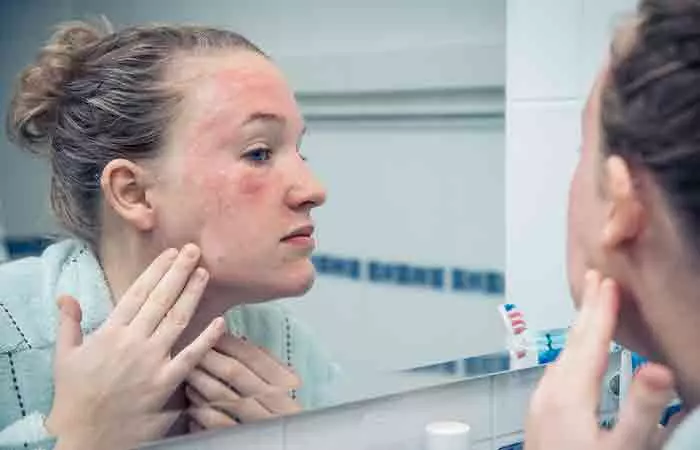
According to the European Scientific Committee on Consumer Safety, phenoxyethanol is safe for all children and adults up to a maximum concentration of 1% ( 4 ). In spite of its liberal use in cosmetic products, phenoxyethanol rarely causes allergic reactions. It is said to be one of the most-tolerated preservatives.
However, very high concentrations of phenoxyethanol (more than 200 times) can lead to adverse systemic reactions. These include:
- Skin irritation
- Eczema
- Hives
- Rashes
This well-tolerated preservative has been reported to cause allergic or adverse reactions in some individuals. This is common with people who are allergic to the substance itself. As per a report, phenoxyethanol caused contact dermatitis in an individual when used as part of an ultrasound gel ( 5 ).
Ingestion or inhalation of phenoxyethanol can cause central nervous system suppression ( 6 ). Hence, infants must not be exposed to phenoxyethanol. For this very reason, nipple creams (that lactating mothers may apply) with phenoxyethanol must be avoided.
How To Spot Phenoxyethanol On Product Labels?
iStock
Phenoxyethanol can be found as an ingredient in cosmetic products in many forms, such as:
- 2-phenoxyethanol
- Phenoxytol
- Ethylene glycol monophenyl ether
- 1-hydroxy-2-phenoxyethane
- PhE
- Dowanol
- Aerosol
- Phenoxetol
- Rose Ether
- Phenoxyethyl alcohol
- Beta-hydroxyethyl phenyl ether
- Euxyl K 400 (a mixture of phenoxyethanol and 1,2-dibromo-2,4-dicyanobutane)
How To Use Phenoxyethanol-Based Skin Products?
iStock
Phenoxyethanol can be found in a wide range of products such as:
- Perfumes
- Deodorants
- Lipsticks
- Foundations
- Blush
- Hand sanitizers
- Soaps and handwash
- Ultrasound gel
People who are not allergic to phenoxyethanol can use products containing this preservative every day. But if at any point one feels allergic to this preservative or develops an adverse reaction, they are advised to stop use and visit a dermatologist immediately.
Whether phenoxyethanol-based skin products must be applied during the day or at night depends upon the product being used. Please check with your dermatologist for further clarification.
Who Shouldn’t Use Phenoxyethanol-Based Skin Care Products?
Shutterstock
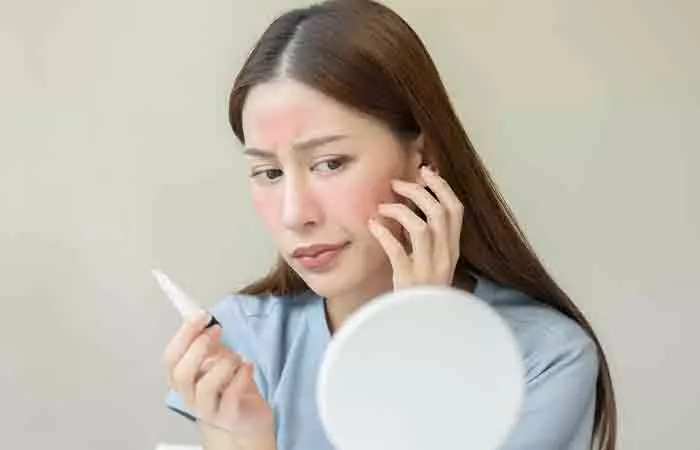
Phenoxyethanol is safe to use in cosmetic and beauty products. However, one can still develop an allergy to it. This is especially true in people with sensitive skin. These individuals must perform a patch test before they use a product containing preservatives like phenoxyethanol.
You can perform a patch test by applying a small amount of the phenoxyethanol-containing product on the back of your hand or wrist and wait for 24 hours. If you do not develop a reaction, you can use the product.
While phenoxyethanol-containing products are safe for everyone, women who are pregnant or breastfeeding must avoid them as there is not enough data to conclusively prove that the preservative is safe. It may be a good idea to consult with your doctor before trying a product containing the preservative.
Infants must not be exposed to phenoxyethanol-containing products.
Individuals with a tendency towards dry skin conditions like eczema and those with sensitive skin must also steer clear of products containing phenoxyethanol.
Infographic: A Guide To Using Skin Care Products With Phenoxyethanol
Phenoxyethanol is used in place of parabens as a preservative in cosmetics and skincare products. While it may prevent bacterial growth on the skin, in rare cases, it may cause an allergic reaction. Check out this infographic to get a deeper understanding of the effect of phenoxyethanol on your skin before including it in your skin care routine.
Phenoxyethanol is used in skin care products, toiletries, and cosmetics as a preservative. While there aren’t many doubts about its efficacy, there are speculations about the safety of using phenoxyethanol for skin as it is often considered a skin irritant. While it is safe to use phenoxyethanol in concentrations up to 1%, you may sometimes develop allergic reactions if you have sensitive skin. Also, pregnant, lactating women, infants, and people with dry skin conditions should steer clear of products containing phenoxyethanol. If you experience any skin issues after using a product with phenoxyethanol, stop using it and consult a doctor.
What steps should I take if I get an allergic reaction to phenoxyethanol?
If you experience an allergic reaction to phenoxyethanol, then immediately stop using the product, cleanse the area with mild soap and water, and apply a soothing cream or aloe vera gel. These products can help reduce redness and itching. However, it’s important to consult a dermatologist for professional advice and to rule out any serious reactions.
Is phenoxyethanol bad for acne?
Phenoxyethanol may help in reducing papules and acne lesions. However, some people’s acne may worsen with the use of phenoxyethanol and may experience burning and redness of the skin ( 9 ).
Is phenoxyethanol good for wrinkles?
No, there is no scientific evidence that suggests that phenoxyethanol is good for wrinkles.
Is phenoxyethanol cancerous?
No, phenoxyethanol itself is not cancerous. However, it may be contaminated with chemicals like 1,4-dioxane which has been linked to cancer ( 10 ).
Illustration: Phenoxyethanol For Skin: Benefits, Side Effects, & How To Use
Image: Stable Diffusion/StyleCraze Design Team
Phenoxyethanol has been the talk of the town lately. Discover everything there to learn about this preservative and its uses. Watch the video below to find out why it’s so popular and what its potential risks are.
References
- Prevalence of Preservatives Across All Product Types in the Contact Allergen Management Program https://pubmed.ncbi.nlm.nih.gov/28098722/
- Cosmetic Preservation: A Review on Present Strategies https://www.ncbi.nlm.nih.gov/pmc/articles/PMC6099538/
- Safety Review of Phenoxyethanol When Used as a Preservative in Cosmetics https://onlinelibrary.wiley.com/doi/full/10.1111/jdv.15944
- Safety review of phenoxyethanol when used as a preservative in cosmetics https://pubmed.ncbi.nlm.nih.gov/31588615/
- Contact dermatitis due to ultrasound gel: A case report and published work review https://onlinelibrary.wiley.com/doi/abs/10.1111/1346-8138.13066
- 2-Phenoxyethanol https://pubchem.ncbi.nlm.nih.gov/compound/2-Phenoxyethanol#section=Inhalation-Risk
- CFR – Code of Federal Regulations Title 21 https://www.accessdata.fda.gov/scripts/cdrh/cfdocs/cfcfr/CFRSearch.cfm?fr=175.105&SearchTerm=ethylene%20glycol%20monophenyl%20etherhttp://www.cosmeticsinfo.org/glossary/letter_e
- 9 Final Report on the Safety Assessment of Phenoxyethanol https://journals.sagepub.com/doi/10.3109/10915819009078737
- Efficacy of octenidine dihydrochloride and 2-phenoxyethanol in the topical treatment of inflammatory acne http://s3-eu-west-1.amazonaws.com/thejournalhub/10.15570/archive/acta-apa-08-3/8.pdf
- BIOASSAY OF 1,4-DIOXANE FOR POSSIBLE CARCINOGENICITY https://ntp.niehs.nih.gov/sites/default/files/ntp/htdocs/lt_rpts/tr080.pdf



Community Experiences
Join the conversation and become a part of our empowering community! Share your stories, experiences, and insights to connect with other beauty, lifestyle, and health enthusiasts.


