What Is It? A type of Alpha Hydroxy Acid (AHA) commonly found in fruits and vegetables.
What Are Its Benefits? It aids digestion, boosts immunity, and improves glucose intolerance.
Who Can Use It? All except people experiencing gastrointestinal infections.
How Often? You can consume 30 mg per day.
Caution It may trigger negative effects, such as nausea and abdominal pain in some individuals.
In This Article
What Is Tartaric Acid?
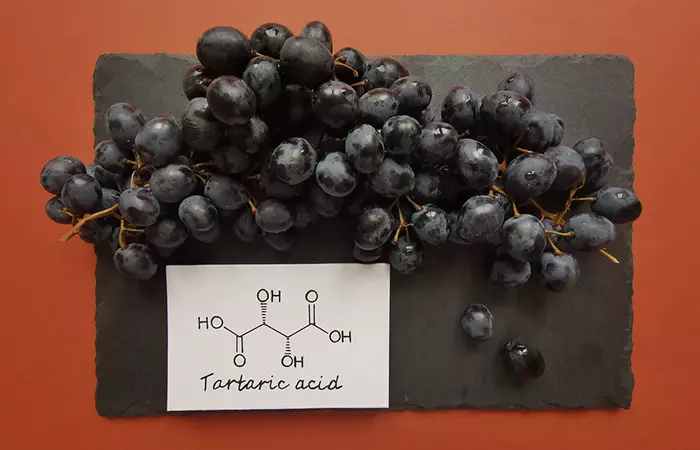
Just like the name suggests, tartaric acid is an organic acid that occurs naturally. It is also a dihydroxyl derivative of succinic acid. When brought to room temperature, it changes to a solid substance that is white and crystalline. The stereochemistry of tartaric acid shows that it has a pair of enantiomers and two chiral centers. The natural form of tartaric acid is L-(+)-tartaric and it is most commonly found enantiomer is D-(-)-tartaric. Tartaric acid is found mostly in foods such as grapes, apricots, apples, avocados as well as sunflower seeds in very high concentrations ( 1 ). Sometimes tartaric acid is also found in sour tamarind that grows in countries such as Africa and other tropical and warm parts of the world.
Key Takeaways
- Tartaric acid may help improve glucose intolerance and digestion.
- It may help boost your immunity.
- There are chances of getting digestive issues if you take it in large amounts.
- Avoid consuming anything with tartaric acid if you are allergic to it.
Tartaric Acid History
Tartaric acid is commonly found in grapes and apricots, but that was discovered quite later. Initially, it was extracted in Nigeria and Sudan and has been used as a food ingredient. Tartaric acid was also used in ancient Spanish cuisine and has been used in several Mexican dishes that use a whole range of dishes. Mexican culture is so fond of this acid that today it has become its largest producer and consumer ( 2 ). Countries such as Spain and Portugal have also used this in their cuisine since the 16th century.

Benefits Of Tartaric Acid
1. Boosts Immunity:

Tartaric acid may help the immune system. However, there is no scientific evidence to back this claim. While tartaric acid is not known to have a direct effect on the immune system, consuming foods and beverages that contain tartaric acid, such as certain fruits and wines, can be part of a healthy diet that supports immune function.
2. Excellent Digestive Aid:

Another health benefit of tartaric acid is that it aids digestion and fights flatulence ( 3 ). It improves intestinal absorption as well which will increase the rate at which healthy nutrients flow into your bloodstream.
3. Improves Glucose Intolerance:
One of the most surprising benefits of tartaric acid is that it significantly improves glucose intolerance.
According to an animal study, tartaric acid was able to improve glucose tolerance in mice by enhancing the activity of certain enzymes involved in glucose metabolism ( 4 ).

Tartaric Acid Side Effects
Did you know tartaric acid comes with several side effects as well? Yes. You should be careful with your intake or you might end up with one of the following side effects.
1. Digestive Problems:

Some individuals may be sensitive or allergic to tartaric acid and may experience digestive problems or other adverse reactions after consuming it. In these cases, it is best to stop intake and seek medical advice.
2. Overeating:

Another problem could be overeating. Anecdotal data suggests that anyone who has consumed a lot of tartaric acid might begin to overeat.
Tartaric Acid Uses
There are several uses of tartaric acid. It acts as a natural preservative that is often used to prepare jams or certain kinds of fruit drinks ( 6 ). Tartaric acid plays a key role in the food industry, primarily as a stabilizer used in baking to improve texture and stability in whipped egg whites. It also acts as a leavening agent alongside baking soda that helps dough rise. Also, tartaric acid serves as a natural preservative in wine production which helps balance acidity and enhance flavor during fermentation. Different candies may also use this.
Infographic: Benefits And Side Effects Of Tartaric Acid
Tartaric acid is a powerful antioxidant that boosts overall immunity and alleviates key health concerns, such as indigestion and flatulence. It is commonly found in grapes, apricots, and apples. Read the infographic to know the benefits and side effects of tartaric acid.
The benefits of tartaric acid are many. It is commonly found in apricots, grapes, and apples. Tartaric acid is rich in antioxidants and helps boost immunity. It also aids in digestion, helps regulate flatulence, and improves intestinal absorption. In addition, tartaric acid also improves glucose intolerance. However, excess intake may trigger negative effects like nausea, abdominal pain, gastrointestinal infections, and overeating. Hence, moderation is highly advised to reap its benefits.
Can tartaric acid remove dark spots?
Anecdotal evidence suggests that tartaric acid, just like other AHAs, helps remove dark spots. In addition, it helps exfoliate skin and treat acne scars.
What is the pH of tartaric acid?
Tartaric acid has a pH of 3.
What’s the difference between citric acid and tartaric acid?
Tartaric naturally occurs in grapes and is available as a white powder, while citric acid is found in citrus fruits and as a solid crystalline compound.
What can I use instead of tartaric acid?
Fumaric acid and cream of tartar, also called potassium bitartrate, which develops after fermentation, are the best alternatives for tartaric acid.
Does turmeric have tartaric acid?
Turmeric does not contain tartaric acid.
Illustration: Amazing Benefits And 2 Side Effects Of Tartaric Acid
Image: Stable Diffusion/StyleCraze Design Team
Tartaric acid has several uses like winemaking and baking. Watch the video below to learn the many benefits that this versatile acid has in store.
References
- Formulation of New Baking (+)-Catechin Based Leavening Agents: Effects on Rheology Sensory and Antioxidant Features during Muffin Preparation https://www.ncbi.nlm.nih.gov/pmc/articles/PMC7693953/
- Tartaric Acid Market Size, Share & Trends Analysis Report By Source (Grapes & Sun-dried Raisins, Maleic Anhydride), By Application (Food, Beverages), By Region, And Segment Forecasts, 2025 – 2026 https://www.grandviewresearch.com/industry-analysis/tartaric-acid-market#:~:text=Europe%20is%20the%20largest%20producer,increased%20usage%20in%20wine%20manufacturing
- A systems biology approach to predict and characterize human gut microbial metabolites in colorectal cancer https://www.ncbi.nlm.nih.gov/pmc/articles/PMC5906656/
- In vivo Antihyperglycemic and Antidyslipidemic Effects of L-Tartaric Acid https://pubmed.ncbi.nlm.nih.gov/36464866/
- Organic Acids Concentration in Citrus Juice from Conventional versus Organic Farming https://www.researchgate.net/publication/216429503_Organic_Acids_Concentration_in_Citrus_Juice_from_Conventional_versus_Organic_Farming
- Tartaric acid https://www.sciencedirect.com/topics/immunology-and-microbiology/tartaric-acid



Community Experiences
Join the conversation and become a part of our empowering community! Share your stories, experiences, and insights to connect with other beauty, lifestyle, and health enthusiasts.